
If you are choosing a wood floor in Metro Vancouver, the engineered versus solid hardwood decision should start with the climate, not the price tag. The coast’s humidity swings reward dimensional stability, and that is where engineered hardwood earns its place. Here is how the two compare for our wet climate, by housing type, with an honest look at where each one belongs.
Key takeaways
- Engineered hardwood is the stable default for Metro Vancouver’s damp climate.
- Solid hardwood still suits some main-floor character-home installs over wood subfloors.
- Over concrete, below grade, or with radiant heat, engineered is the clear choice.
- Stability is not the same as mold-proof; the subfloor and moisture control still matter.
Why the coast favours engineered
Engineered hardwood is real wood over a cross-layered plywood or HDF core. That construction resists the expansion and contraction that Vancouver’s wet-winter, dry-summer cycle forces on wood. It can be floated, glued or nailed, which suits the varied subfloors found across Metro Vancouver homes and condos.
Where solid hardwood still works
Solid hardwood remains a beautiful choice for above-grade main floors in character and heritage homes with sound wood subfloors and stable indoor humidity. It can be sanded and refinished many times, which appeals to owners restoring an older home. It is not the right pick over concrete, below grade, or over radiant heat.
By housing type
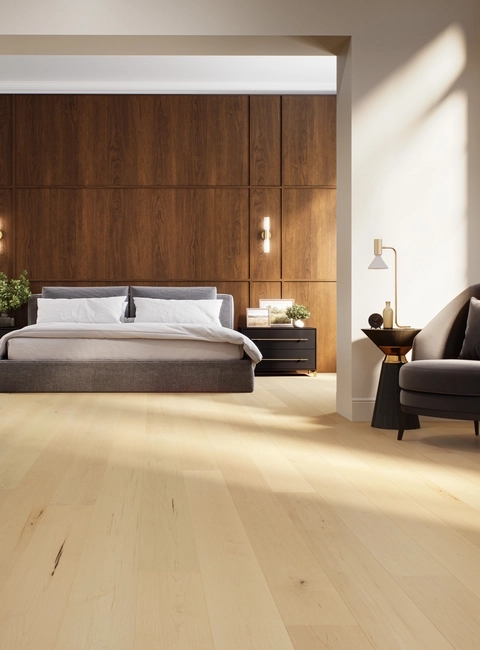
In a concrete condo, engineered hardwood over a strata-rated underlay is the answer; solid wood does not belong on a slab. In a pre-war character home with wood subfloors, either can work, and many owners restore the original solid floors. In a new build, engineered hardwood handles construction moisture and radiant heat with less risk.
The honest caveat
Engineered hardwood is dimensionally stable, but stability is not the same as mold resistance. If subfloor moisture or vapour drive is not addressed first, problems can still develop underneath any wood floor. Substrate preparation and moisture testing matter as much as the product you choose.
Install methods on the coast
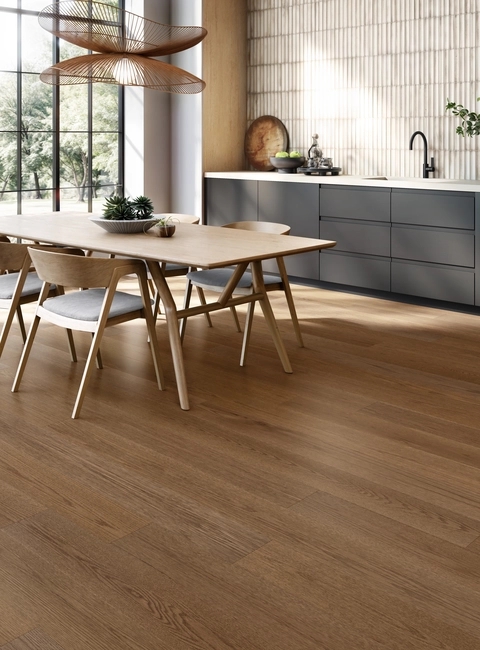
Engineered hardwood’s flexibility is a real advantage here. It can float over an acoustic underlay in a condo, glue down to a tested concrete slab, or nail to a wood subfloor in a house. The right method depends on your subfloor and your building, and choosing it correctly protects the floor long term.
Dimensional stability, explained
The whole comparison turns on one idea: how much the floor moves. Solid hardwood is a single piece of wood that expands and contracts mostly across its width as humidity changes, so a wide solid plank moves more than a narrow one. Engineered hardwood is built from a real-wood top layer bonded over a cross-laid plywood or fibreboard core, and those opposing layers fight each other’s movement. The result is a board that stays far flatter and tighter through the seasonal swing our coast imposes.
That stability is why engineered is the default recommendation here, and why it can go places solid cannot. Over a concrete slab, below grade, or above radiant heat, the constant or uneven moisture and temperature would push solid wood past its limits, while a quality engineered floor takes it in stride. The look on the surface can be identical; the behaviour underneath is not.
Install method changes the answer
Engineered hardwood can be floated over an acoustic underlay, glued to a tested slab, or nailed to a wood subfloor, which lets it suit almost any Metro Vancouver home, from a downtown concrete tower to a North Shore house. Solid hardwood is generally nailed to a wood subfloor and does not belong on a slab or over radiant heat. In a home that mixes slab and framed levels, that flexibility often decides the project on its own.
Cost, lifespan, and refinishing
Solid hardwood’s advantage is longevity through refinishing: a solid floor can be sanded and recoated many times across its life, which is part of why heritage floors survive a century. Engineered floors can also be refinished, but only within the thickness of the wear layer, so a 2 millimetre layer may allow one careful pass while a 4 to 6 millimetre layer allows two or three. On price, the two overlap heavily; a premium engineered floor can cost more than a basic solid one, so the climate fit, not the sticker, should lead the decision here.
How Canadian Home Style helps
We match the product and install method to your home and the coast, prepare and test the subfloor, and stand behind the result. One local team from our North Vancouver showroom guides you from selection to a floor built to last.
Book a showroom consultation or request an in-home consultation, and our team will help you choose a floor built for the coast and install it to last.
Related guides
Frequently asked questions
Is engineered hardwood real wood?
Yes. It is a real-wood top layer over a stable engineered core, which is what gives it dimensional stability for the coast.
Can I refinish engineered hardwood?
Often once or twice, depending on the wear-layer thickness. Solid hardwood can be refinished more times, which matters in heritage restorations.
Which is better for a Vancouver condo?
Engineered hardwood, paired with a strata-rated underlay over the concrete slab. Solid wood is not suited to a slab.
How many times can engineered hardwood be refinished?
It depends on the wear layer. A 2 millimetre layer may allow one light pass; a 4 to 6 millimetre layer often allows two or three.
Why can’t solid hardwood go over radiant heat?
Solid wood moves too much with the temperature cycling radiant heat creates. Engineered hardwood’s stable core handles it far better.
Is engineered hardwood always cheaper than solid?
No. Prices overlap, and premium engineered floors can cost more than basic solid ones. On the coast, choose for stability first, not price alone.